
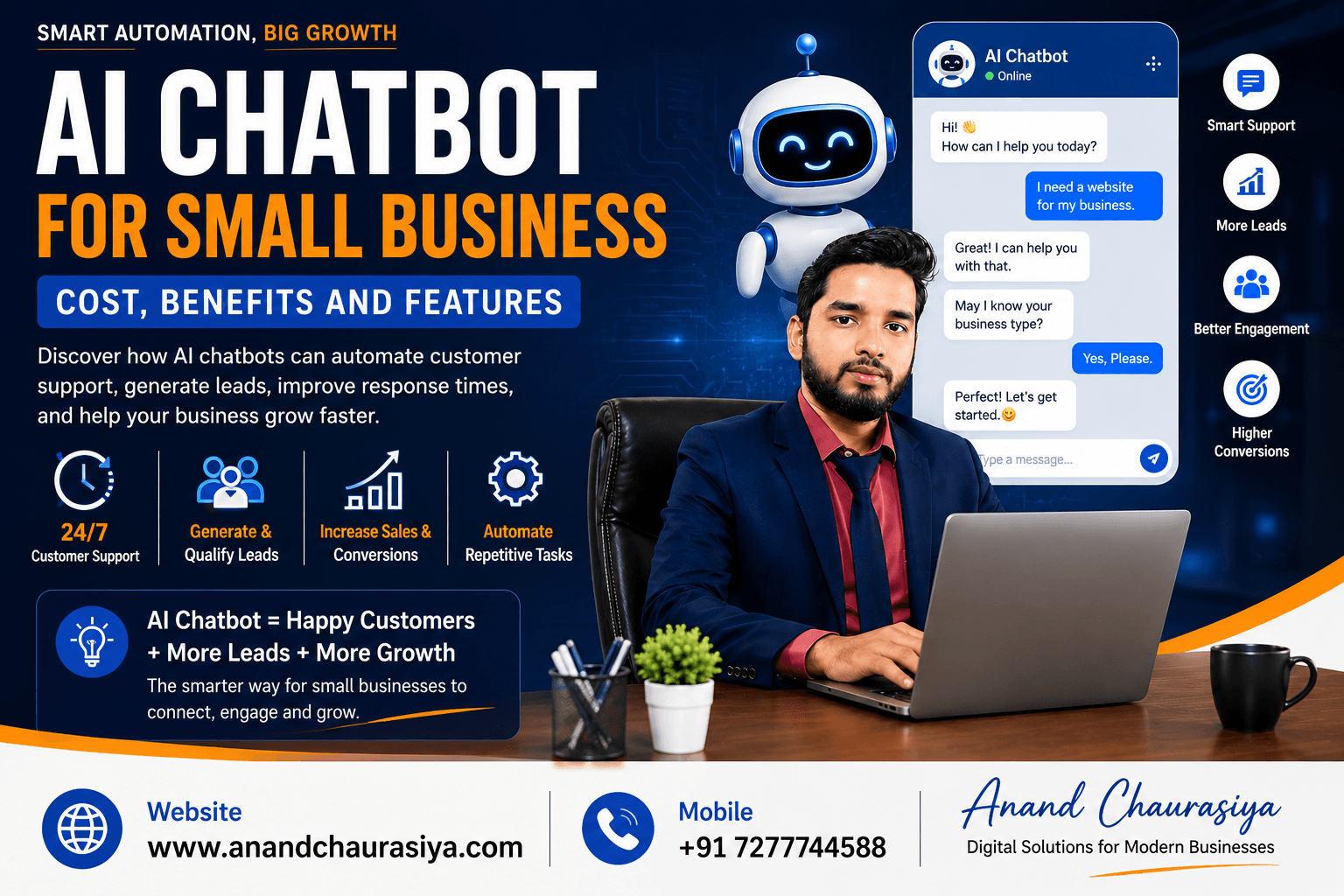
AI Chatbot for Small Business: Cost, Benefits and Features
Introduction: Is Your Small Business Ready for an AI Chatbot?
Imagine this: A potential customer visits your website at 11:30 PM. They want to know your service price, ask whether you serve their location, and want to book an appointment.
But you're sleeping.
By the time you wake up, the customer has already contacted another business.
This is exactly where an AI chatbot for small business can make a difference.
An AI chatbot can interact with website visitors, answer frequently asked questions, collect customer details, qualify leads, and guide people toward the next step—often without requiring a team member to respond manually to every message.
For small businesses, this is especially useful because resources are limited. You may not have a large customer support team or someone available 24/7 to answer every enquiry.
The good news? You don't always need an expensive enterprise-level AI system. A well-designed chatbot focused on your actual business needs can be a practical investment.
In this guide, we'll explore the cost, benefits, features, use cases, and limitations of AI chatbots for small businesses, along with practical examples for businesses in India and Bangalore.
What Is an AI Chatbot for Small Business?
An AI chatbot is software that uses artificial intelligence and conversational technology to communicate with customers through a website, messaging platform, or other digital channel.
Unlike a traditional chatbot that only follows fixed buttons and predefined scripts, modern AI chatbots can understand natural language and respond to questions based on their available knowledge.
For example, imagine you run a web development company in Bangalore.
A visitor might type:
"How much does a business website cost?"
Instead of asking the visitor to search through multiple pages, your AI chatbot could respond:
"The cost of a business website depends on the number of pages, features, design requirements, and integrations. Would you like to share your requirements? I can help you request a quote."
The chatbot could then collect:
-
Name
-
Phone number
-
Email address
-
Business type
-
Website requirements
-
Budget
-
Preferred contact time
That information can then be sent to the business owner or sales team.
The result is simple: the customer gets an immediate response, and the business gets a potential lead.
Why Are AI Chatbots Becoming Popular Among Small Businesses?
Small businesses are increasingly looking for ways to do more with fewer resources.
Customers also expect quick responses. If someone has a question about your service and doesn't receive an answer quickly, they may move on to a competitor.
Modern AI chatbots can help businesses remain available outside normal working hours, handle repetitive questions, and support lead generation. However, the real value depends on how well the chatbot is designed and how closely it matches the business's actual workflow.
For example, a local business in Bangalore may receive enquiries from customers at different times of the day. An AI chatbot can answer basic questions instantly while allowing complex conversations to be transferred to a human.
Practical Takeaway
Don't build a chatbot simply because "AI is trending."
Start by identifying the questions customers ask repeatedly. If your team answers the same 10 questions every day, those questions are an excellent starting point for your chatbot.
AI Chatbot Cost for Small Business
One of the first questions business owners ask is:
"How much does an AI chatbot cost?"
The honest answer is: it depends.
There is no single price for every business because chatbot costs depend on the complexity of the project, AI model, integrations, number of users, hosting, maintenance, and development requirements.
A basic chatbot may cost significantly less than a custom AI assistant connected to CRM software, WhatsApp, payment systems, appointment booking, and internal business databases.
Here is a general cost structure:
| Chatbot Type | Typical Cost Range |
|---|---|
| Basic FAQ chatbot | ₹5,000 – ₹20,000+ |
| AI website chatbot | ₹15,000 – ₹50,000+ |
| Custom AI chatbot | ₹30,000 – ₹1,00,000+ |
| Advanced chatbot with integrations | ₹75,000 – ₹3,00,000+ |
| Monthly AI/API/hosting costs | Depends on usage |
These figures are only broad estimates. Actual pricing can vary significantly depending on functionality and development requirements.
For a small business, the best approach is usually to start with a focused chatbot and expand it later.
Practical Takeaway
Instead of asking:
"How much does an AI chatbot cost?"
Ask:
"How much does it cost to solve my specific customer communication problem?"
A chatbot that answers FAQs and captures leads may be enough for one business. Another may need appointment booking, CRM integration, WhatsApp automation, and multilingual support.
Benefit 1: 24/7 Customer Support
One of the biggest advantages of an AI chatbot for small business is availability.
Your business doesn't close just because your office does.
Customers may visit your website:
-
Early in the morning
-
During lunch breaks
-
Late at night
-
On weekends
-
During holidays
An AI chatbot can provide instant answers to common questions at any time.
For example, a Bangalore-based salon could use a chatbot to answer:
-
What are your opening hours?
-
Where are you located?
-
What services do you provide?
-
How much does a haircut cost?
-
Can I book an appointment?
The customer doesn't have to wait until the next morning.
Practical Takeaway
Create a list of your 20 most frequently asked questions and use them as the foundation of your chatbot's knowledge base.
Benefit 2: Generate More Leads
Getting website traffic is great.
But traffic without leads doesn't pay the bills.
An AI chatbot can turn passive website visitors into potential customers by starting conversations.
Instead of waiting for visitors to find your contact page, the chatbot can ask:
"Hi! Are you looking for a website for your business?"
The visitor can then select:
-
Business Website
-
eCommerce Website
-
Landing Page
-
Website Redesign
-
SEO Services
The chatbot can collect their details and pass the information to your sales team.
Practical Example
Suppose 1,000 people visit your website every month.
Even if only a small percentage start a conversation, you may discover potential customers who would otherwise leave without contacting you.
Practical Takeaway
Don't make your chatbot just a question-answering tool. Give it a clear goal, such as lead generation, appointment booking, quotation requests, or customer support.
Benefit 3: Faster Customer Responses
Speed matters in digital marketing.
A customer who receives an immediate response may be more likely to continue the conversation than someone who has to wait several hours.
For example:
Customer: "Do you provide website development in Bangalore?"
Chatbot: "Yes. We provide custom website development services for businesses in Bangalore and across India. Would you like to discuss your project?"
The conversation has already started.
The customer doesn't need to search for your phone number or email address.
Practical Takeaway
Use your chatbot to answer simple questions immediately and provide a clear next action, such as Call Now, Get a Quote, Book a Consultation, or Talk to an Expert.
Benefit 4: Reduce Repetitive Work
Let's be honest.
Many businesses spend hours answering the same questions again and again.
"What's your price?"
"Where are you located?"
"Do you provide this service?"
"What are your timings?"
"How long does delivery take?"
An AI chatbot can handle many repetitive questions automatically, allowing your employees to focus on more important tasks.
This doesn't mean replacing your entire customer support team.
Instead, think of the chatbot as a first-line assistant.
It handles basic questions while your team handles conversations that require human judgement.
Practical Takeaway
Look at your WhatsApp chats, emails, and customer calls from the last month. Identify repeated questions and train your chatbot around them.
Benefit 5: Better Lead Qualification
Not every lead is a good lead.
A chatbot can ask qualifying questions before sending a lead to your sales team.
For example, a web development chatbot could ask:
-
What type of website do you need?
-
Do you already have a domain?
-
Do you have hosting?
-
What is your estimated budget?
-
When do you want to start?
Now the sales team receives more useful information.
Instead of:
"I need a website."
They receive:
"Business owner needs a 10-page website, already has a domain, budget is ₹50,000, and wants to start this month."
That's a much better conversation.
Practical Takeaway
Create 3–5 qualification questions that help your sales team decide which leads need immediate attention.
Benefit 6: Improve Customer Experience
Customers don't want complicated experiences.
They want answers.
An AI chatbot can make your website easier to navigate by guiding visitors toward the information they need.
For example:
Welcome! How can I help you today?
-
Explore Services
-
Get a Quote
-
Book a Call
-
Check Pricing
-
Talk to Support
This creates a simple customer journey.
Practical Takeaway
Keep your first chatbot message short. Give users clear options instead of overwhelming them with a long paragraph.
Key Features of an AI Chatbot for Small Business
Not every business needs every feature.
The right chatbot should include features that support your actual business goals.
Here are some of the most useful features.
1. Natural Language Understanding
The chatbot should understand normal human questions instead of forcing customers to use specific keywords.
For example:
"How much does your website design service cost?"
and
"What's the price for a website?"
should ideally lead to a similar answer.
2. Business Knowledge Base
A good AI chatbot should be trained or configured using reliable business information.
This may include:
-
Website content
-
FAQs
-
Service details
-
Product information
-
Pricing information
-
Business policies
-
Location details
-
Operating hours
The better the information, the more useful the chatbot can be.
Practical Takeaway
Keep your chatbot's knowledge base updated whenever your prices, services, or policies change.
3. Lead Capture
Lead capture is one of the most valuable features for service businesses.
The chatbot can collect:
-
Name
-
Email
-
Phone number
-
Business name
-
Requirements
-
Budget
-
Location
This information can be stored or sent to the business owner.
4. Human Handoff
AI shouldn't try to answer everything.
If the chatbot doesn't know the answer or the customer wants to speak to a person, the conversation should be transferred to a human.
A good chatbot should be able to say:
"I'm not completely sure about that. Let me connect you with our team."
This is better than giving the customer an incorrect answer.
5. WhatsApp Integration
For Indian businesses, WhatsApp can be an important communication channel.
A chatbot strategy can potentially connect website enquiries with messaging workflows, depending on the tools and APIs used.
For example:
Website Visitor → AI Chatbot → Lead Capture → WhatsApp/Sales Team
This can create a smoother customer journey.
However, businesses should carefully review the platform's policies, API requirements, and messaging costs before implementation.
Practical Takeaway
If most of your customers communicate through WhatsApp, consider making WhatsApp part of your overall customer communication strategy—not just adding a chatbot to your website.
6. Appointment Booking
Businesses such as:
-
Salons
-
Clinics
-
Consultants
-
Coaching centres
-
Real estate agencies
-
Digital marketing agencies
can use chatbot workflows to help customers request or schedule appointments.
For example:
"Would you like to book a free consultation?"
The customer selects a preferred date and time, and the system can continue the booking process through the appropriate calendar or scheduling integration.
7. Multilingual Support
India is a multilingual market.
Depending on your audience, supporting English and regional languages can make your chatbot more accessible.
For businesses targeting Bangalore, you might consider English plus commonly used local languages based on your customer base.
Practical Takeaway
Don't add languages just because you can. First understand which languages your actual customers use.
8. Analytics and Reporting
A chatbot should ideally help you understand customer behaviour.
Useful metrics include:
-
Number of conversations
-
Number of leads
-
Most common questions
-
Conversion rate
-
Drop-off points
-
Most popular services
-
Human handoff requests
These insights can help improve your website and marketing strategy.
AI Chatbot Use Cases for Small Businesses
Almost every industry can potentially benefit from conversational automation, but the use case should match the business.
Real Estate
A chatbot can:
-
Capture buyer requirements
-
Ask about budget
-
Share property information
-
Collect contact details
-
Schedule callbacks
Restaurants
A chatbot can:
-
Share menus
-
Answer opening-hour questions
-
Provide location information
-
Handle basic booking enquiries
Clinics
A chatbot can:
-
Share basic information
-
Provide operating hours
-
Help with appointment requests
-
Direct patients to appropriate contact channels
Sensitive medical questions should always be handled carefully, with appropriate human or professional escalation.
Education and Coaching
A chatbot can answer:
-
Course fees
-
Course duration
-
Admission questions
-
Batch timings
-
Course features
Web Development Companies
A chatbot can qualify potential clients based on:
-
Website type
-
Number of pages
-
Required features
-
Budget
-
Timeline
This is particularly useful for agencies and freelancers.
AI Chatbot for Small Business in Bangalore
Bangalore is one of India's largest technology and startup hubs, making it a strong market for AI automation and digital business solutions.
Local businesses across areas such as Whitefield, Electronic City, Koramangala, Indiranagar, HSR Layout, Marathahalli, Jayanagar, JP Nagar, and Bellandur can use AI chatbots to improve their online customer experience.
For example, a local SEO agency in Bangalore could use an AI chatbot to answer questions about SEO packages.
A real estate business could use one to capture property requirements.
A software company could use one to qualify B2B leads.
A restaurant could use one to answer menu and reservation questions.
The important point is that an AI chatbot should be designed around the customer's journey—not simply added to a website as a decorative feature.
If you're looking for AI chatbot development in Bangalore or want to explore AI automation for small businesses, you can learn more about digital solutions and services from Anand Chaurasiya.
Practical Takeaway
For a Bangalore business, combine your chatbot strategy with local SEO, Google Business Profile optimization, fast website performance, and strong lead follow-up. A chatbot works best when it is part of a complete digital marketing system.
How Much Can an AI Chatbot Save a Small Business?
The answer depends on how many conversations the chatbot handles and how much time your team currently spends on repetitive enquiries.
Imagine a small business receives 500 monthly enquiries.
If employees spend an average of 5 minutes handling each basic enquiry, that's approximately:
500 × 5 minutes = 2,500 minutes
That's more than 41 hours of staff time.
If a chatbot successfully handles a meaningful portion of routine questions, your team could potentially spend more time on sales, customer relationships, and complex support.
However, businesses should not assume that every chatbot automatically produces huge savings. The real value depends on usage, implementation quality, customer adoption, and how well the chatbot fits the business process.
Practical Takeaway
Before investing, calculate how many hours your team spends answering repetitive questions every month. This gives you a realistic starting point for estimating potential ROI.
AI Chatbot vs Traditional Chatbot
What's the difference?
Traditional Rule-Based Chatbot
Usually works with:
-
Predefined buttons
-
Fixed scripts
-
Keyword matching
-
Decision trees
It can be useful for simple workflows.
AI-Powered Chatbot
Can potentially:
-
Understand natural language
-
Handle varied questions
-
Use business knowledge
-
Maintain conversational context
-
Generate dynamic responses
For small businesses, a hybrid approach can sometimes be the best solution.
Use fixed flows for important actions such as lead capture and booking, while using AI for natural conversations and FAQs.
Practical Takeaway
Don't use AI where a simple button works better. Use AI where understanding natural language genuinely improves the customer experience.
What Are the Limitations of AI Chatbots?
AI chatbots are powerful, but they aren't perfect.
They may:
-
Give incorrect information
-
Misunderstand complex questions
-
Fail to understand unusual requests
-
Need regular knowledge updates
-
Require human intervention
-
Create privacy and security considerations
This is why businesses should avoid letting a chatbot confidently invent answers.
A good chatbot should have clear boundaries.
If it doesn't know something, it should say so.
For important topics such as legal, financial, medical, or sensitive customer issues, businesses should consider appropriate human review and escalation.
Practical Takeaway
Build a "fallback strategy."
If the chatbot cannot confidently answer a question, it should:
-
Admit it doesn't know.
-
Collect the customer's details.
-
Notify the business team.
-
Offer a human support option.
How to Choose the Right AI Chatbot for Your Business
Before choosing a chatbot platform or hiring an AI chatbot development company in Bangalore, ask these questions:
1. What problem am I solving?
Is it:
-
Customer support?
-
Lead generation?
-
Appointment booking?
-
Sales?
-
FAQs?
2. Where are my customers?
Do they use:
-
Website chat?
-
WhatsApp?
-
Facebook?
-
Instagram?
-
Other platforms?
3. What integrations do I need?
You may need:
-
CRM
-
Email
-
WhatsApp
-
Calendar
-
Google Sheets
-
Payment gateway
-
Customer database
4. How will I measure success?
Choose metrics such as:
-
Leads generated
-
Appointments booked
-
Response time
-
Support tickets reduced
-
Conversion rate
Practical Takeaway
Start with one measurable business objective. For example:
"I want my chatbot to generate 30 qualified leads per month."
That's much better than:
"I want an AI chatbot because everyone is using AI."
How to Get Started With an AI Chatbot
You don't need to build the most complicated system on day one.
Start small.
Step 1: Identify FAQs
Write down your top customer questions.
Step 2: Define the Goal
Choose one primary goal:
Support, sales, leads, or bookings.
Step 3: Prepare Business Information
Create a reliable knowledge base containing accurate information.
Step 4: Design the Conversation
Plan how the chatbot should respond to common questions.
Step 5: Add Lead Capture
Ask for contact information at the right point in the conversation.
Step 6: Add Human Handoff
Make it easy for customers to contact a real person.
Step 7: Measure Results
Track conversations, leads, conversions, and unanswered questions.
Step 8: Improve Continuously
Review chatbot conversations regularly and update its knowledge.
The Future of AI Chatbots for Small Businesses
The future isn't simply about having a chatbot.
It's about building AI-powered customer journeys.
Imagine a system where:
Customer visits website
↓
AI chatbot answers questions
↓
Lead is qualified
↓
Customer books a meeting
↓
CRM is updated
↓
Sales team receives notification
↓
Follow-up happens automatically
This is where AI becomes more than a chat window.
It becomes part of your business automation system.
As AI-powered search and conversational discovery continue to evolve, businesses also need to think about how their brand information is presented across search engines and AI-driven experiences. This means combining traditional SEO with strong, accurate, helpful content that clearly explains who you are, what you offer, and where you operate.
For young marketers and business owners, this creates an exciting opportunity: AI isn't just a customer support tool—it can become part of your complete digital marketing and sales strategy.
Final Thoughts: Is an AI Chatbot Worth It for Your Small Business?
An AI chatbot for small business can be a valuable investment when it solves a real problem.
The biggest benefits are usually:
-
24/7 availability
-
Faster customer responses
-
Automated FAQ support
-
Lead generation
-
Lead qualification
-
Reduced repetitive work
-
Better customer experience
-
Appointment assistance
-
Business insights
But remember: the chatbot itself isn't the strategy.
The strategy is understanding your customers and creating a smoother journey from visitor → conversation → lead → customer.
Whether you're running a startup, local business, eCommerce store, agency, clinic, coaching centre, or service company, start with a simple question:
"What repetitive customer problem can I automate today?"
That's where your AI chatbot journey should begin.
If you're interested in AI chatbot development in Bangalore, AI automation, website development, or digital marketing solutions, explore Anand Chaurasiya to learn more about building a stronger digital presence for your business.
What do you think about AI chatbots for small businesses? Would you use one on your website for customer support, lead generation, or sales? Share your thoughts in the comments and don't forget to share this article with another business owner who is exploring AI automation.
Comments (0)
No comments yet. Be the first to share your thoughts!